
AGB99 Deposit Limits: How They Work
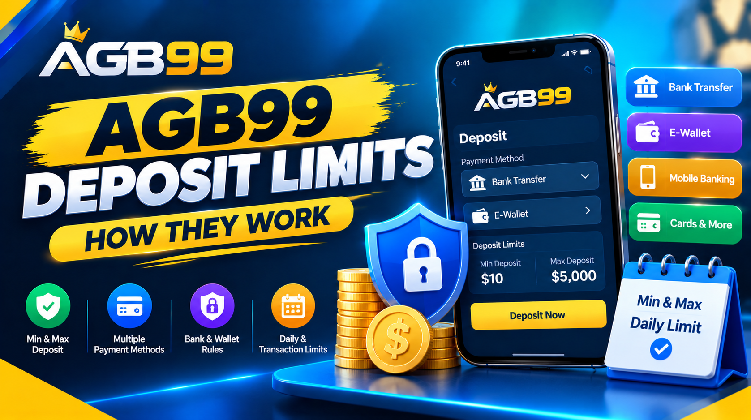
Understanding deposit limits is an important part of managing online payments. When using https://agb99play.com/, the amount you can deposit may depend on the payment method, account status, transaction conditions, and the limits currently displayed in your account. A minimum deposit determines the smallest amount you can send, while a maximum deposit limits how much you can add through a particular payment option.
These limits are not always identical across every payment method. Bank transfers, e-wallets, mobile banking, and other payment services can have different transaction rules. Therefore, users should always check the current deposit screen before making a payment rather than relying on an old number from an article or screenshot.
What Is an AGB99 Deposit Limit?
An AGB99 deposit limit is a restriction on how much money can be added to an account through a particular payment method or within a specified period.
There are usually two main types:
Minimum deposit: The smallest amount accepted for a transaction.
Maximum deposit: The largest amount that can be deposited through a particular payment method or within a specific period.
A payment method may also have daily, weekly, or monthly transaction limits. These can be separate from the limit shown by the platform.
Why Are Deposit Limits Used?
Deposit limits serve several practical purposes.
Payment providers often impose transaction limits for security, compliance, and account-management reasons. Online platforms may also establish their own limits for individual payment methods.
For example, an e-wallet might allow smaller transactions than a bank transfer. A bank may also have its own daily transfer limit that is independent of the platform’s deposit limit.
This means that the actual amount you can deposit can be determined by the lowest applicable limit among the platform, payment method, and provider.
Minimum vs Maximum Deposit
The difference is simple.
A minimum deposit tells you how little you can deposit.
A maximum deposit tells you how much you can deposit under the applicable limit.
For example, if a payment method displays a minimum of 500 units and a maximum of 50,000 units, a transaction below 500 or above 50,000 may not be accepted through that method.
The numbers in this example are only for illustration. Users should always rely on the current limits shown for their own payment method.
Do All AGB99 Payment Methods Have the Same Limits?
Not necessarily.
Payment methods can have different limits because each provider operates under its own transaction rules.
Bank transfers may support larger transactions, while e-wallets or mobile payment services may have lower individual or daily limits.
Current online gaming payment pages using similar payment systems commonly show different minimum and maximum amounts for mobile wallets, bank transfers, and other methods, demonstrating why a single universal number should not be assumed.
For an AGB99 deposit, always check the amount shown after selecting your specific payment method.
How to Check Your Current AGB99 Deposit Limit
Checking the current limit is usually straightforward.
Step 1: Log In
Sign in to your account using the normal login process.
Step 2: Open the Deposit Section
Navigate to the payment or deposit area of your account.
Step 3: Select a Payment Method
Choose the bank, wallet, mobile payment service, or other available option you want to use.
Step 4: Check the Displayed Limits
Look for the minimum and maximum amount shown for that payment method.
Step 5: Check for Additional Conditions
Some payment methods may have daily or transaction-based restrictions in addition to the amount shown on the deposit screen.
This process is more reliable than using an old third-party guide because payment options and limits can change.
Why Can Limits Change?
Deposit limits can change for several reasons.
Payment providers may update their transaction policies. A platform may also change its supported payment channels or adjust limits based on operational or security requirements.
Your account status can sometimes matter as well.
For this reason, a limit that was available previously may not necessarily be available today.
Whenever you plan to make a deposit, check the current information displayed by the platform and payment provider.
Bank Transfer Deposit Limits
Bank transfers can sometimes support larger transactions than certain digital wallets, but this is not guaranteed.
The bank itself may impose daily transfer limits. The platform may also have a separate maximum deposit amount.
Therefore, even if your bank allows a particular transfer amount, the platform may not accept the entire amount through its deposit system.
Before transferring a larger amount, check both the bank’s transaction limit and the current AGB99 deposit limit.
E-Wallet Deposit Limits
E-wallets can have their own balance and transaction restrictions.
These limits may depend on the wallet account’s verification level, transaction type, or provider rules.
This means that an e-wallet could have one limit for a single transaction and another limit for total daily activity.
If an AGB99 deposit is rejected because of a wallet limit, increasing the amount repeatedly will not solve the problem. You may need to use an amount within the permitted range or select another officially supported payment method.
What Happens If You Deposit Below the Minimum?
A transaction below the required minimum may fail or may not be processed as a valid deposit.
For example, if a payment method requires a certain minimum and you send less than that amount, the transaction may not automatically become a normal deposit.
If this happens, do not immediately send another payment.
First, check the transaction status and payment instructions. Keep the transaction reference or receipt in case support needs to investigate the payment.
What Happens If You Try to Deposit Above the Maximum?
A transaction above the displayed maximum may be rejected.
In some cases, the payment provider itself may prevent the transaction because the amount exceeds its permitted limit.
If you need to deposit a larger amount, do not assume that splitting transactions is automatically allowed. Multiple transactions may still be subject to daily or other cumulative limits.
Instead, check the platform’s current rules and available payment methods before proceeding.
Daily Deposit Limits
A daily deposit limit is different from a single-transaction maximum.
Suppose a payment method permits several transactions during a day but also has a daily cumulative limit. Reaching that daily amount could prevent additional deposits even if another individual transaction would normally fall within the single-payment range.
This is why checking only the minimum and maximum shown beside a payment method may not always provide the complete picture.
If you plan to make several deposits on the same day, check whether a cumulative limit applies.
Payment Provider Limits vs AGB99 Limits
One of the most important things to understand is that there may be multiple layers of limits.
Platform Limit
This is the amount allowed by the platform for the selected payment method.
Payment Provider Limit
This is the amount allowed by your bank, e-wallet, or payment service.
Account Limit
Your particular account may also be subject to additional restrictions based on verification or other conditions.
The transaction can only proceed when the amount satisfies the applicable requirements.
Why Was My Deposit Rejected Even Though It Was Within the AGB99 Limit?
There can be several explanations.
Your payment provider may have a lower limit than the platform. Your account may have reached a daily transaction limit. The payment method may also be temporarily unavailable.
Other possibilities include:
- Incorrect payment details
- Insufficient available balance
- Account verification requirements
- Payment-provider restrictions
- Temporary technical problems
- An expired or changed payment instruction
Therefore, a rejected transaction does not automatically mean that the platform’s displayed limit is incorrect.
Can You Increase Your Deposit Limit?
That depends on the applicable rules.
Some limits are controlled by the payment provider and cannot be changed by the platform. Other restrictions may depend on account verification or platform-specific conditions.
If your required amount is higher than the displayed limit, check whether another officially supported payment method provides a suitable limit.
Do not attempt to bypass a restriction by creating additional accounts or using another person’s payment account.
Does a Higher Deposit Limit Mean a Better Payment Method?
Not necessarily.
A payment method with a higher maximum may not be the best option for every user.
When comparing payment methods, consider:
- Transaction limits
- Processing time
- Fees
- Security
- Availability
- Verification requirements
- Ease of tracking transactions
A smaller-limit method may be perfectly suitable if you only need to make modest transactions.
Deposit Limits and Responsible Spending
Deposit limits can also be useful as a personal budgeting tool.
A platform’s maximum limit should never be treated as a recommended spending amount.
Just because a payment method allows a larger transaction does not mean you need to deposit that amount.
Before making a deposit, decide how much you can comfortably afford to spend. Avoid increasing your deposit simply because a larger limit is available.
Online gaming involves financial risk, and a deposit limit does not protect you from losing money.
Common Deposit Limit Mistakes
Assuming One Limit Applies Everywhere
Different payment methods can have different limits.
Using Old Information
Limits can change, so an older article may no longer be accurate.
Ignoring Payment Provider Limits
Your bank or wallet can impose restrictions independently of the platform.
Making Repeated Transactions
Multiple deposits can potentially count toward a daily or cumulative limit.
Trying to Bypass Restrictions
Do not create multiple accounts or use someone else’s payment details to get around a deposit restriction.
Forgetting Fees
A transaction may be within the deposit limit but still involve a payment-provider fee.
What to Do When You Reach Your Deposit Limit
If you have reached the current deposit limit, first confirm whether it is a single-transaction limit or a daily or cumulative limit.
Then check when the relevant limit resets, if the payment provider or platform provides that information.
If you still need assistance, contact the official support channel and ask about the currently available payment options.
Avoid sending additional money through an unofficial payment destination simply because your preferred method has reached its limit.
AGB99 Deposit Limit Checklist
Before making an AGB99 deposit, check:
- What is the minimum deposit?
- What is the maximum deposit?
- Is the limit per transaction?
- Is there a daily limit?
- Does your bank or wallet have a separate limit?
- Are there any applicable fees?
- Is your payment method currently supported?
- Does your account require verification?
- Are the payment instructions current?
- Have you saved your transaction receipt?
This quick checklist can help prevent many common payment problems.
Final Thoughts
Understanding AGB99 deposit limits is relatively simple once you separate minimum limits, maximum limits, daily limits, and payment-provider restrictions. The amount you can deposit may depend on more than one factor, so there is no reason to assume that every payment method will have identical limits.
Bank transfers, e-wallets, and mobile payment services can each have their own transaction rules. Your platform account may also have separate conditions.
The safest approach is to select your payment method, check the current minimum and maximum shown in your account, and then confirm whether your bank or wallet has additional restrictions. Do not rely on an old limit found in a previous guide or screenshot.
Finally, remember that a higher deposit limit is not an indication that you should deposit more. Set your own spending boundary, use only money you can afford to lose, and never attempt to bypass account or payment restrictions. If a transaction is rejected or remains unclear, check the existing transaction status and use the platform’s official support channel rather than repeatedly sending money.