
Timing the Slump: Fading Overvalued Giants in the 2008-09 Bundesliga
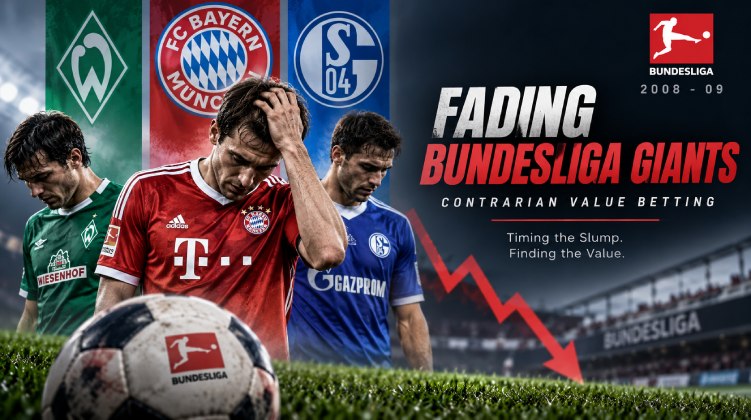
Contrarian handicapping reaches its highest mathematical efficacy when the general public continues to price elite clubs based on past silverware, while the underlying pitch data signals severe tactical decay. The 2008-09 German Bundesliga served as an extraordinary demonstration of this dynamic, as traditional heavyweights repeatedly surrendered points to tactically modern mid-table sides. By recognizing the precise inflection point where managerial friction, defensive disorganization, and physical fatigue intersect, disciplined bettors gained the confidence to fade prominent favorites laying inflated margins, turning public market bias into consistent spread profitability.
Why Public Brand Anchoring Creates High-Yield Fade Spots
Recreational betting handles systematically anchor to legacy status, creating a persistent pricing buffer that insulates famous clubs from immediate market downgrades. When a European powerhouse enters a downturn, bookmakers cannot simply slash their implied win probability overnight without exposing their books to massive liabilities from casual money eager to back famous names at cut-rate prices. Consequently, clubs like Bayern Munich, Werder Bremen, and Schalke 04 continued to lay hefty -1.0 or -1.5 spreads throughout the 2008-09 campaign despite displaying systemic structural cracks.
This commercial inertia opens a lucrative window for analytical handicappers. The sharp bettor does not wait for a heavy favorite to lose three matches in a row before fading them; by that point, the market has finally caught up and adjusted the spread downward. The actual mathematical edge lies in striking during the initial phase of structural decay, where public perception remains overwhelmingly positive while tactical balance has already evaporated on the pitch.
Dissecting the Collapse Rates of Underperforming Powerhouses
Fading top-tier clubs requires cataloging the structural reasons behind their regular-season struggles, separating temporary bad luck from fundamental tactical insolvency.
The quantitative breakdown of the league’s established brands illustrates why blind faith in pre-season favorites eroded betting balances across the thirty-four matchdays:
| Traditional Powerhouse | Expected Pre-Season Tier | Actual Final Table Finish | Spread Failure Rate (%) | Primary Tactical Point of Failure |
| Bayern Munich | 1st (Title Favorite) | 2nd (-2 pts off lead) | 58.8% | Disjointed Rest-Defense; Transitional Chaos |
| Werder Bremen | Top 3 Contender | 10th (Mid-Table Slump) | 64.7% | Unbalanced Midfield Overcommitment; High Line |
| FC Schalke 04 | Champions League Tier | 8th (European Exclusion) | 55.9% | Sterile Possession; Complete Striker Isolation |
| Bayer Leverkusen | European Contender | 9th (Second-Half Freefall) | 52.9% | Fullback Overextension; High Concessions |
These metrics confirm that traditional status offered zero protection against handicap failure. Werder Bremen failed to cover in nearly two-thirds of their league fixtures, dragged down by an offensive structure that left their backline hopelessly exposed. Bayern Munich generated negative yields despite finishing second, proving that a high finishing position still results in financial bleeding when pre-match expectations demand multi-goal blowouts that the tactical system cannot deliver.
Jürgen Klinsmann’s Bayern Munich and the Illusion of Domestic Control
Bayern Munich’s 2008-09 campaign under Jürgen Klinsmann remains the definitive modern case study in fading an elite brand. Klinsmann attempted to install a progressive, attack-minded framework without establishing the compact defensive transition mechanics required to support it. Bayern consistently committed both fullbacks high up the pitch, leaving central defenders Lucio and Martín Demichelis to defend vast expanses of open grass against rapid counter-attacks.
The market routinely priced Bayern as prohibitive -1.5 or -1.75 favorites against lower-half opponents like Hannover 96 and Energie Cottbus. Yet, because Bayern conceded forty-two goals on the season, even comfortable leads frequently deteriorated into chaotic 3-2 or 2-2 finishes. Bettors who identified Bayern’s inability to control counter-attacks profited heavily by backing underdog spreads, understanding that Klinsmann’s high-possession setup produced high-risk game states that favored the plus-handicap.
Thomas Schaaf’s Werder Bremen: The Ultimate Negative-Handicap Trap
Werder Bremen entered the season with a fearsome attacking reputation powered by Diego, Mesut Özil, and Claudio Pizarro, yet they finished the campaign in a disappointing tenth place. Thomas Schaaf operated with tactical dogmatism, deploying a high defensive line regardless of opponent or game context. Bremen conceded fifty league goals, rendering them completely incapable of consistently covering negative Asian handicaps.
Bremen was repeatedly priced as a heavy home favorite at the Weserstadion based on their explosive offensive talent. However, whenever they encountered organized low-block sides with disciplined aerial defenders, their prolonged attacks resulted in turnovers that immediately exposed their stationary central midfielders. Fading Bremen on the spread yielded massive returns, as oddsmakers routinely set lines expecting runaway high-scoring triumphs that Bremen’s leaky backline could not sustain.
The Diagnostic Anatomy of an Impending Tactical Downturn
Spotting the exact matchday to fade a giant requires tracing the internal deterioration that precedes public drops in form.
The Phased Breakdown of an Overextended Powerhouse
When an elite side begins to lose its tactical grip, performance degrades through an observable, repeatable sequence:
- Phase 1: Spatial Disconnection. The defensive midfield screen fails to drop in sync with the backline, creating a ten-meter void directly in front of the penalty area.
- Phase 2: Chance Quality Inversion. Although the favorite dominates overall possession metrics, their shot quality plummets to low-probability long-range attempts, while the opponent creates high-danger breakaways.
- Phase 3: Physical Exhaustion. Prolonged possession without defensive containment forces frantic thirty-meter backward recovery sprints, draining the squad’s biological energy reserves by the 65th minute.
- Phase 4: Mental Demoralization. Conceding a soft counter-attacking goal triggers reckless forward charges, eliminating defensive shape entirely and resulting in margin-breaking defeats.
Pinpointing teams entering Phase 1 or Phase 2 enables handicappers to step in front of public sentiment and back the underdog before the mainstream market begins to adjust prices downward.
Market Divergence: Spotting Odds Inefficiencies Across Global Spreads
The most profitable fade opportunities occur when market sentiment moves in the opposite direction of tactical reality, creating glaring price discrepancies. Following a scrappy, undeserved win by a struggling giant, public bettors frequently double down, misinterpreting a fortunate result as a sign of an impending turnaround.
In situations where a prominent club scrapes past an inferior opponent despite being dominated in transition chances, analyzing opening Asian handicap movements through an established web-based service reveals valuable contrarian positioning; monitoring sharp money shifts on ufabet เครดิตฟรี illustrates how professional syndicates systematically take the points against struggling favorites whose underlying defensive performance metrics point to sustained structural decline. Backing the plus-handicap before public liquidity forces the spread back toward an accurate equilibrium allows bettors to capture maximum closing line value.
Deriving Value from Alternative Markets During Heavy Favoritism
Occasionally, a struggling powerhouse faces an opponent so modest that taking a standard +1.5 handicap still carries discomfort. In these specific contexts, smart contrarian execution involves seeking out alternative derivative props that isolate the favorite’s functional deficiency without requiring the underdog to secure a clean result.
Whenever an elite club demonstrates chronic difficulty in penetrating packed defensive shells, exploring specialized match propositions via an interactive casino site highlights effective options for fading public sentiment; assessing alternate line pricing through casino online demonstrates the financial logic of targeting team total unders on the favorite or wagering on low-scoring margin bands rather than sweating a full-match handicap. Schalke 04 provided multiple lucrative spots for this approach in 2008-09, as their complete lack of offensive imagination resulted in frequent 0-0 and 1-0 finishes that fell well short of bookmaker expectations.
Reversal Thresholds: Knowing When to Stop Fading a Giant
The primary hazard of contrarian betting is overstaying the position. Every struggling giant eventually encounters a corrective bottom where market prices drop so far that fading them loses its positive expected value, or internal management changes abruptly restore tactical balance.
Recognizing the exact signals that invalidate a fade thesis prevents sharp bettors from handing back accumulated gains:
- Managerial Dismissal: The removal of a tactically compromised coach routinely produces an immediate physical bounce and a simplification of defensive assignments.
- Market Overcorrection: The favorite’s spread drops to a flat pick’em or -0.25 line against mid-table opposition, erasing the mathematical edge of backing the underdog.
- Systemic Formation Shift: The manager drops an isolated attacking player in favor of an additional holding midfielder, directly rectifying the transition gap that was being exploited.
- Opponent Incompetence: The underdog lacks the basic passing accuracy or athletic pace required to execute the counter-attacks that typically punish the giant’s high line.
When VfB Stuttgart replaced Armin Veh with Markus Babbel midway through the 2008-09 campaign, their immediate return to defensive basics instantly invalidated fade positions, transforming them from a prime target into one of the league’s best spread-covering teams.
Summary
Fading struggling giants during the 2008-09 Bundesliga season proved that public brand loyalty consistently lags behind tactical truth, creating substantial inefficiencies across spread markets. Bayern Munich’s porous rest-defense under Klinsmann and Werder Bremen’s unhedged offensive system generated reliable profit margins for handicappers willing to oppose them on plus-handicaps. Successfully timing these fade spots requires identifying the early warning signs of tactical detachment, separating deceptive lucky wins from genuine form, and knowing precisely when managerial corrections or market over-adjustments close the profitable window. Ultimately, sustainable betting yields come from treating football teams as dynamic tactical units rather than static reputations, exploiting the market inertia that blinds the public to a powerhouse in decline.